
Pigs Can't Afford Straw, Sticks, or Bricks, Settle for "Starter Home" That Is a Cardboard Box Listed at $389,000, Wolf Eats All Three
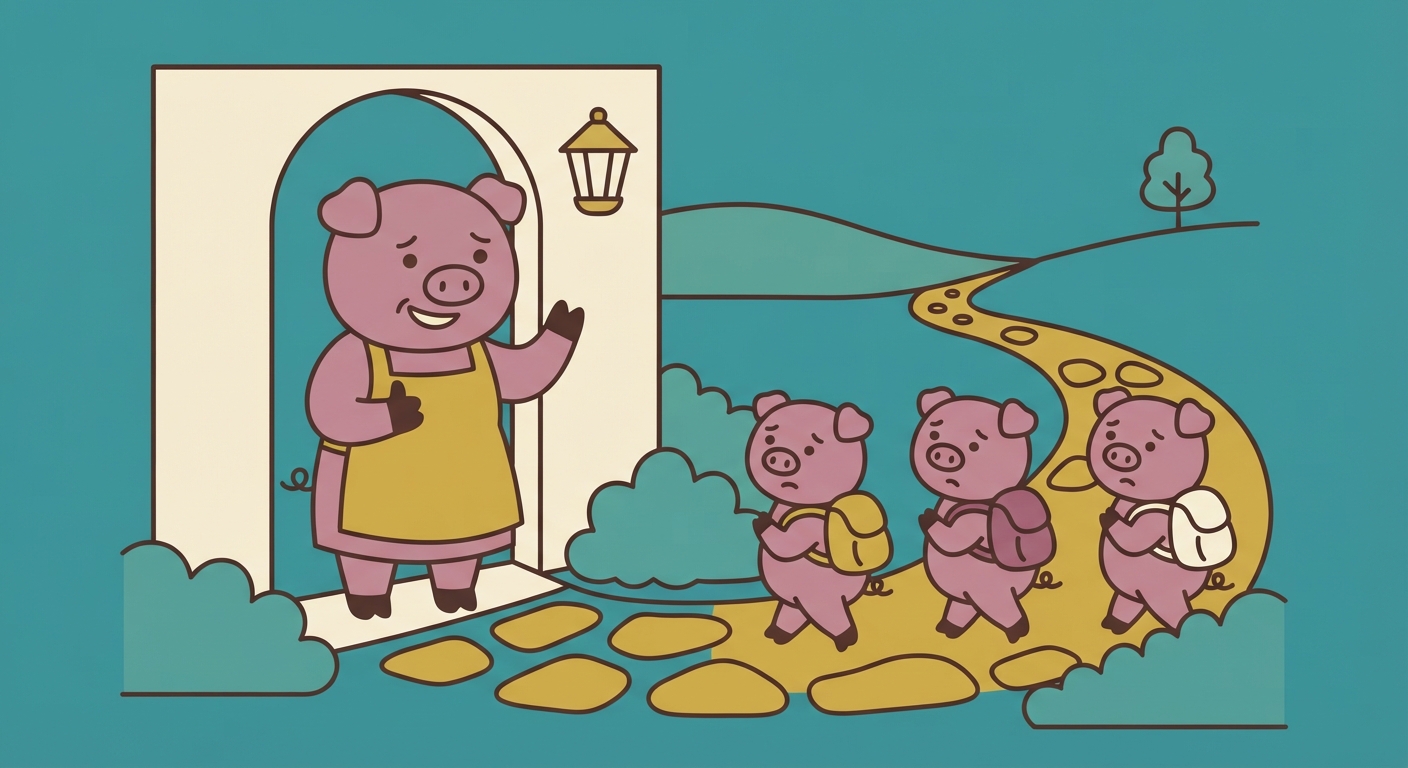
PHOENIX, AZ — A stark new edition of The Three Little Pigs, published this week under the title The Three Little Pigs: 2026 Edition, concludes with the story's beloved trio pooling their savings to purchase a cardboard box listed as a "cozy starter home" for $389,000, before the Big Bad Wolf, unimpeded by any meaningful structure, simply walks in and eats all three of them.
"We wanted to be honest with children about the state of the housing market," said author Jonathan Reese. "In the original story, at least one pig survives because he can afford bricks. In 2026, nobody can afford bricks. So the pigs pool their money and buy the only thing in their price range. And the only thing in their price range is a box."
The book follows the three pigs as they search for housing. The first pig tours a straw house, but discovers the asking price is $520,000 "due to strong demand for rustic, natural materials." The second pig tours a stick house listed at $610,000 and described as "a charming fixer-upper with incredible potential," which upon inspection turns out to be four sticks leaning against a tree. The third pig visits a brick house, only to learn that it is under contract after receiving 41 offers in one afternoon.
Desperate, the pigs combine their savings and approach a realtor, who shows them a refrigerator box behind a strip mall.
"It's a great starter home," the realtor says in the book. "Open concept. Natural lighting through the flaps. Plenty of room to grow. And it's in a great school district."
The pigs are approved for a 30-year mortgage at 7.4% interest, sign 142 pages of closing documents, and move into the box, which their HOA immediately fines for "unapproved exterior cardboard."
That night, the Big Bad Wolf arrives at the box.
"Little pigs, little pigs, let me come in," the wolf says.
"Not by the hair of our chinny-chin-chins!" the pigs reply.
The wolf pauses, then simply lifts one of the flaps and steps inside.
The book's final illustration, which reviewers have described as "devastating," shows the wolf sitting outside the empty box, patting his stomach, while a "For Sale" sign is planted in the dirt beside him, listing the box at $412,000 and noting that it is "move-in ready."
"Children need to understand consequences," Reese said. "The lesson of the original story was that hard work and good materials will protect you. The lesson of our story is that sometimes the materials are just too expensive, and then the wolf eats you."
Early reviews have been polarizing. Several parents reported that their children cried at the ending, while others said the book prompted meaningful family conversations.
"My son asked why the pigs didn't just build a stronger house," said Denver mother Amanda Collins. "I told him they couldn't afford one. He asked why. I told him interest rates. He asked what interest rates were. Now he's eight and he's afraid of the Federal Reserve."
Reese said the book is meant to be educational, not cruel. "Every generation tells this story differently," he said. "Ours just happens to have a wolf and a mortgage."
At press time, the cardboard box had been purchased sight unseen by a private equity firm for $430,000, which announced plans to rent it out as a short-term vacation property on Airbnb.
Back to the front page